On Wednesday 5 November 2026 Finance Minister François-Philippe Champagne released Budget 2026: Masters of our destiny. The primary record is the Finance Canada news release, the Key Measures backgrounder, and the 532-page budget PDF at budget.canada.ca (Annex 1 tables A1.4–A1.8).
What the fiscal tables say
- Budgetary balance (deficit): Annex Table A1.8 projects −$39.3 billion in 2025–26, then −$62.3 billion (2026–27), −$62.5 billion (2027–28), −$57.6 billion (2028–29), −$53.4 billion (2029–30) and −$52.9 billion (2030–31).
- Deficit as a share of GDP: −1.2%, −1.8%, −1.8%, −1.6%, −1.4%, −1.3% over those same years — a declining path after 2027–28.
- Compared with the Spring Economic Update 2026: SEU had projected larger deficits (e.g. −$65.3 billion in 2026–27 and −$63.1 billion in 2027–28). Budget 2026 still shows deep deficits, but smaller than that SEU track after economic and fiscal developments.
- Day-to-day operating balance (Table A1.6, capital-budgeting framework): −$2.0 billion (2025–26), −$3.5 billion (2026–27), then +$11.2 billion in 2027–28 and larger surpluses later. The release says this meets the operating-spending anchor a year ahead of the Budget 2025 schedule. That balance adds estimated forgone revenue from capital-supporting tax measures (including the Productivity Mega Deduction) to revenues; it is not the same as the headline budgetary balance.
- Public debt charges: $53.5 billion (2025–26) rising to $60.2, $67.3, $73.8, $78.4 and $85.5 billion by 2030–31.
- Federal debt-to-GDP (Table A1.8): about 40% across the horizon (40.2% in 2025–26; 39.9% in 2026–27; 40.1% in 2030–31).
Growth and energy measures (as costed in the budget)
- Productivity Mega Deduction: Key Measures says it would lower the marginal effective tax rate on new business investment from 13% to 6.4%.
- Canada Strong Fund / Notes: Canadians could invest in a $25 billion Canada Strong Fund via Canada Strong Notes.
- National Electricity Strategy: investing over $50 billion toward doubling electricity grid capacity by 2050; nuclear strategy $518.5 million; critical minerals $2.3 billion; EV charging just over $634 million (over 55,000 additional chargers).
- News-release “key facts” also list $400 billion in capital investments over six years and $22 billion of new affordability measures, and say direct program spending growth is lowered from 8% to 2%. Those headline packaging lines are Finance’s own summary; the Annex tables above are the detailed fiscal path.
Household and housing lines in the Key Measures backgrounder
- 2027 Canada Groceries and Essentials Benefit Supplement: a one-time 50% increase for the 2026–27 benefit year, delivered in early 2027 — up to $339 for a single person without children and up to $679 for a couple with two children.
- Nutrition North Canada funding expanded/stabilised (northern food costs).
- Canada Caregiver Credit made fully refundable — up to $1,260 annually for 2027 (indexed after).
- Housing: $44.7 billion over 11 years on a cash basis, framed as a path to end homelessness within 10 years.
Immigration Levels Plan (inside the budget book)
Budget 2026’s narrative on the 2027–2029 Immigration Levels Plan cites charted targets of about 380,000 permanent-resident admissions and 370,000 new temporary-resident arrivals per year in that window (IRCC source note dated 31 August 2026 in the chart). Treat those as the budget’s stated plan figures, not a separate IRCC release pulled this morning.
Citizen impact
Households should watch the groceries supplement rules and timing, caregiver-credit refundability, and any provincial pass-through of housing and electricity spending — none of which are automatic cash in hand on budget day. Taxpayers fund rising public-debt charges even while Finance claims an earlier operating-balance date under a capital/operating split. Businesses evaluating the Mega Deduction need the detailed eligibility rules in the budget chapters, not the METR headline alone. This article reports Finance’s published tables; it is not a scorecard of whether every political promise will clear Parliament or survive costing revisions.
Primary record: Finance Canada release; Key Measures backgrounder; Budget 2026 PDF (Annex 1).
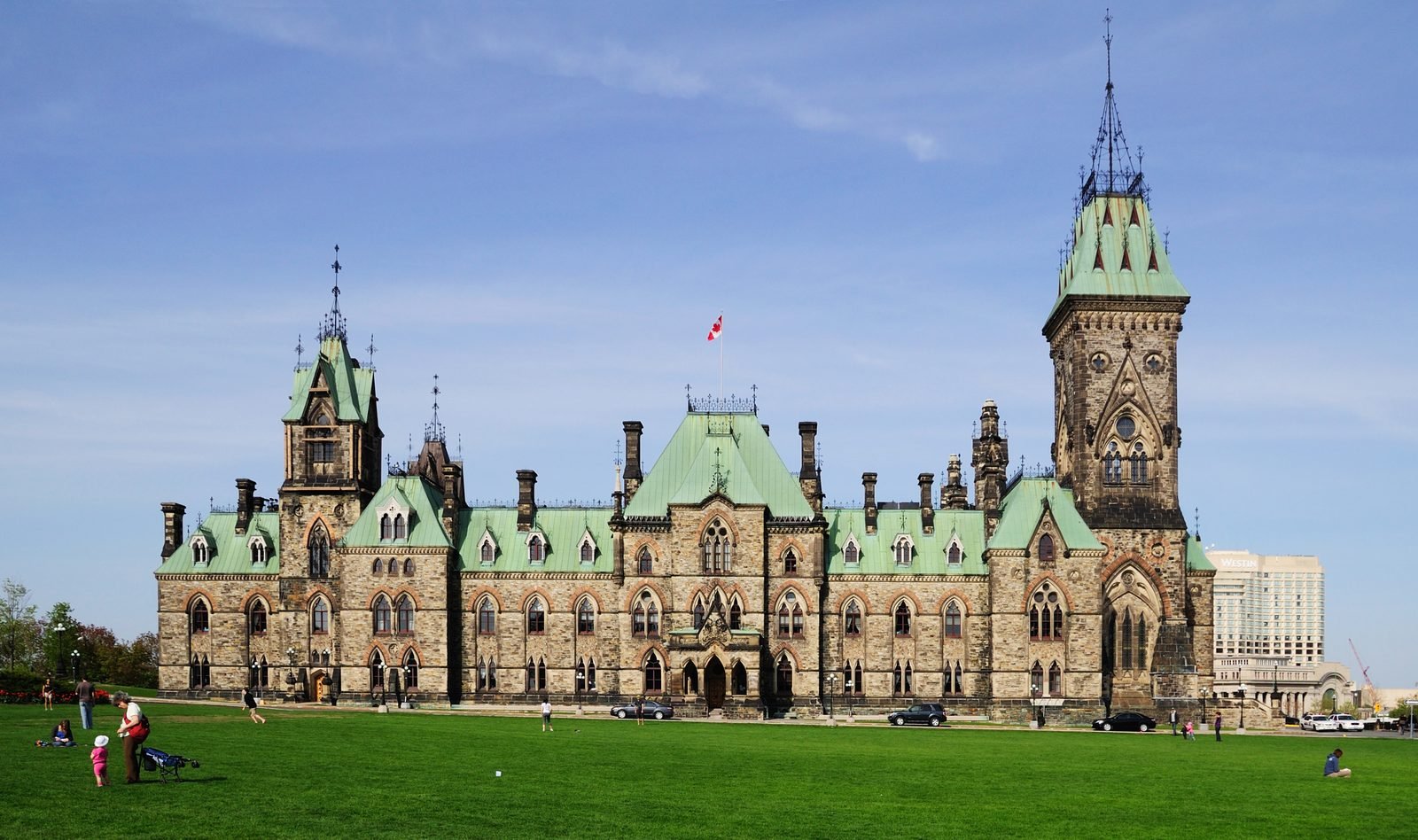
East Block, Parliament Hill, Ottawa (illustrative of the federal budget setting; not a photo of the 5 November budget lock-up). Photo: Wladyslaw, CC BY-SA 3.0; resized/recompressed.